
New API Design And Build
REST for most cases, GraphQL where clients need nested data in a single call, gRPC between your own services. Built with versioning, authentication, rate limits, and OpenAPI documentation from the first endpoint.

Services / Web Development
We build APIs, and the integrations that join your systems together. Integration work fails in the same few places: no agreed system of record, no plan for when the other side is down, and direct connections that multiply. Five systems need ten connections between them. Ten systems need forty-five. We route through one layer instead.
REST for most cases, GraphQL where clients need nested data in a single call, gRPC between your own services. Built with versioning, authentication, rate limits, and OpenAPI documentation from the first endpoint.

Payment gateways, CRMs, ERPs, logistics carriers, identity providers. We map the authentication lifecycle, rate limits, and error responses before writing code, because that is where most integrations break.
Older systems that speak SOAP, exchange files, or offer no API at all. We build an adapter layer that exposes their data to modern applications without touching the system underneath.
Replacing direct system-to-system links with a single hub. New systems connect to the hub rather than to everything else, so adding the next one does not mean rewriting the last five.
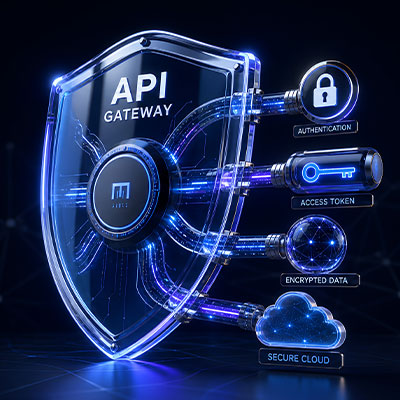
OAuth 2.0 and token management, rate limiting, request validation, key rotation, and gateway policies on Kong, AWS API Gateway, or Azure API Management. Every call logged for audit.
Wrapping your existing APIs so AI assistants and agents can use them, with scoped permissions setting what each one may read or change. Your REST and GraphQL endpoints stay exactly as they are.
Six ways to work with us.
Backend developers and QA in two- to four-week sprints. Suits a defined set of integrations with a fixed end date.
A full-cycle team building the API alongside the application it serves, from design through to documentation.
Long-term developers working only on your integration roadmap. Webmyne handles recruitment, payroll, legal, and HR.
One or two specialists for a fixed period, such as a developer to connect a single payment provider.
Scope and budget agreed before work starts. Suits a known number of endpoints against documented third-party APIs.
Monitoring and the work that follows when a provider changes its API or retires a version. Connectors break on someone else's schedule.
Which systems, which direction the data flows, and which one wins when they disagree.
Endpoint design, field mapping, authentication, and the agreed latency for each flow.
Sprint development, with retries, idempotency keys and error handling written in, not bolted on.
Contract tests, failure simulation, load testing against rate limits, and security testing before release.
Deployment, OpenAPI documentation, monitoring and alerting, then support under an agreed response time.
Send us the systems you need joined, and the documentation for anything third-party. You will get a scope with the failure handling included, rather than an estimate that discovers it later.
Plan your projectA read-only connection usually takes one to three weeks. A transactional write integration takes three to six. Two-way synchronisation runs six to twelve weeks or longer, because identity matching needs decisions from your team, not ours.
Providers retire versions on their own schedule. We subscribe to their deprecation notices, keep integrations on supported versions, and recommend holding a maintenance allocation for the work their changes create. It is a running cost, not a one-off.
Direct is fine for two or three systems with stable interfaces. Past that the arithmetic turns against you: five systems need ten connections, ten need forty-five. A hub costs more up front and much less by the fifth system.
REST for most APIs and for any third-party consumer. GraphQL when clients pull nested data and you want to avoid repeated round trips. gRPC between your own services, where speed matters more than browser support.
You do, on full payment: source code, OpenAPI specifications, credentials and deployment configuration. Provider accounts for payment gateways and similar services are opened in your name, not ours.