Build
LLM development & customization
We develop customized LLM applications using APIs, RAG pipelines, embeddings, vector databases, and enterprise data.

Ready when you are
Start a projectServices / Software Development
Extend what applications can do with customised models, multimodal integration, advanced prompting, and more.
We develop customized LLM applications using APIs, RAG pipelines, embeddings, vector databases, and enterprise data.
We select foundation models and design LLM architectures for performance, security, scalability, interoperability, and cost efficiency.

We integrate multimodal LLMs with text, image, audio, and video inputs, supported by OCR and document processing.

We engineer system prompts, few-shot prompts, and prompt chains to improve accuracy, consistency, instruction following, and output quality.
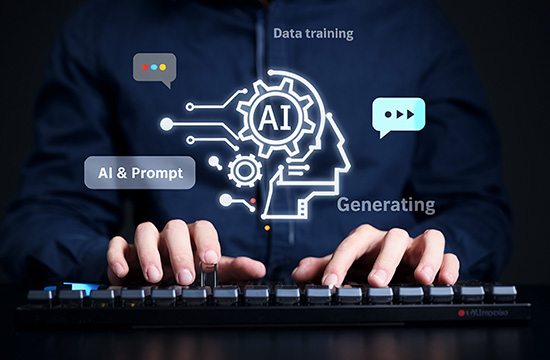
We fine-tune supported foundation models using domain-specific datasets and PEFT methods such as LoRA to improve specialized task performance.

We address the architecture, data, security, and operational requirements behind reliable enterprise LLM integration.
Define the workflows, users, and business outcomes the LLM integration needs to support.
Connect enterprise data, applications, APIs, and knowledge sources with the LLM through a secure, scalable integration architecture.
Design an architecture that connects models with existing systems without disrupting core business operations.
Build controls for access, data privacy, permissions, and model outputs across different workflows.
Prepare the integration for reliable performance, manageable costs, and measurable results at enterprise scale.
We test LLM integrations against real-world scenarios to validate response quality, accuracy, reliability, and expected business outcomes before release.
Your process, existing systems and constraints, written up as requirements with an estimate and its assumptions.
Architecture, data model, integrations, and a backlog split into releases, including what version one leaves out.
Two-week sprints, each ending in working software on a staging environment you can access.
Functional, performance and security testing alongside the build, with automated regression on everything already shipped.
Deployment, data migration, user training and handover documentation, then support under an agreed SLA.
Bring your applications, data, and AI use cases to us, and we’ll engineer the integration architecture around them.
Plan your projectLLM integration services connect large language models such as OpenAI GPT, Anthropic Claude, Google Gemini, Meta Llama, and Mistral with applications, enterprise data, APIs, databases, and business workflows. Integrations can include model APIs, RAG pipelines, tool calling, security controls, evaluation, and production monitoring.
Depending on the architecture, our LLM integration stack can include Python, TypeScript, Java, FastAPI, LangChain, LangGraph, LlamaIndex, OpenAI models, Anthropic Claude, Google Gemini, Meta Llama, Mistral, Amazon Bedrock, Microsoft Foundry Models, Gemini Enterprise Agent Platform, PostgreSQL, MongoDB, Redis, vector databases, Docker, Kubernetes, and major cloud platforms.
RAG connects an LLM to external knowledge through a retrieval pipeline. The system indexes relevant data, retrieves context for each query, and passes it to the model before it generates a response. We can implement RAG using technologies such as LangChain, LlamaIndex, Pinecone, Weaviate, Qdrant, pgvector, and Elasticsearch.
Yes. We can connect LLM applications to internal documents, databases, knowledge bases, APIs, and other proprietary data through controlled retrieval and integration layers. We can also implement authentication, authorization, encryption, PII controls, and data isolation.
We monitor response quality, retrieval performance, latency, token usage, cost, errors, and model behavior through evaluation and LLMOps workflows. Depending on the architecture, we can use MLflow, LangSmith, Evidently, OpenTelemetry, and custom observability solutions.